The Resource Curse. Literature Review
DOI:
https://doi.org/10.35319/lajed.202645622Keywords:
Natural resource curse, resource dependence and economic growth, dutch disease, institutional quality and rent-seeking, economic complexity, energy transitionAbstract
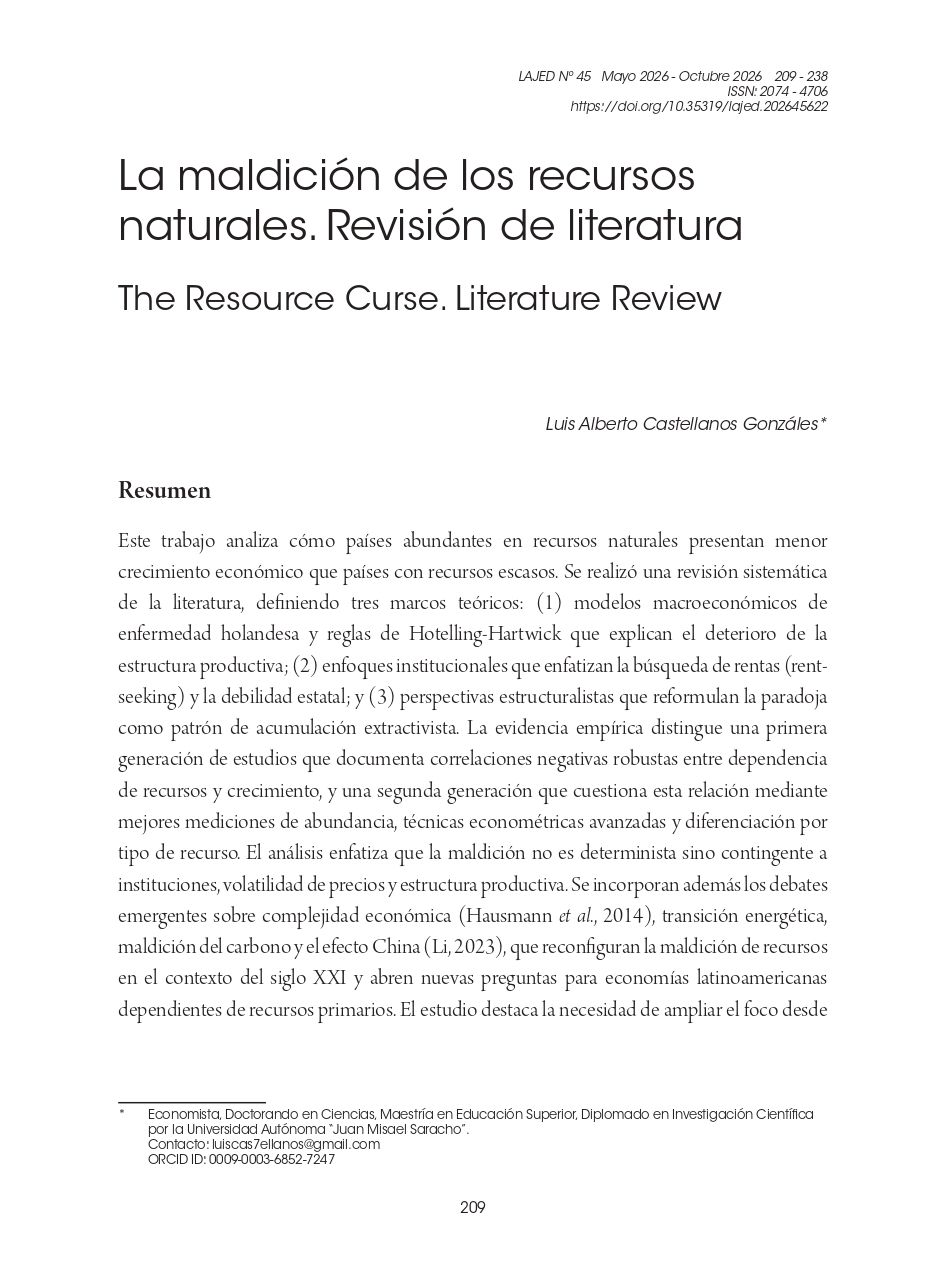
This paper analyzes how countries abundant in natural resources exhibit lower economic growth than countries with scarce resources. A systematic literature review was conducted, defining three theoretical frameworks: (1) macroeconomic models of Dutch disease and Hotelling-Hartwick rules that explain the deterioration of the productive structure; (2) institutional approaches that emphasize rent-seeking and state weakness; and (3) structuralist perspectives that reformulate the paradox as a pattern of extractive accumulation. Empirical evidence distinguishes a first generation of studies that documents robust negative correlations between resource dependence and growth, from a more recent second generation that challenges this relationship through improved measures of abundance, advanced econometric techniques, and differentiation by resource type. The analysis emphasizes that the resource curse is not deterministic but contingent on institutions, price volatility, and productive structure. The paper also incorporates emerging debates on economic complexity (Hausmann et al., 2014), energy transition, the carbon curse, and the China effect (Li, 2023), which reconfigure the resource curse debate in the twenty-first century context. It highlights the need to broaden the focus from GDP to wider dimensions of development: distributive equity, conflict, environmental sustainability, and the well-being of local communities.
Downloads
References
Abraham, J. M. y Hennessy, D. A. (2021). A subnational carbon curse? Fossil fuel richness and carbon intensity among US states. Energy Research & Social Science, 79, 102179.
Acosta, A. (2012). Extractivismo y neoextractivismo: dos caras de la misma maldición. En M. Lang y D. Mokrani (eds.), Más allá del desarrollo. Grupo Permanente de Trabajo sobre Alternativas al Desarrollo. Fundación Rosa Luxemburgo, México
Auty, R. M. (1993). Sustaining development in mineral economies: The resource curse thesis. Londres: Routledge.
---------- (1994). Economic reform and the resource curse thesis. World Development, 22(1), 11-26.
---------- (2001). Resource abundance and economic development. Oxford University Press.
---------- (2007). The resource curse and sustainable development. En G. Atkinson, S. Dietz y E. Neumayer (Eds.), Handbook of sustainable development (pp. 207-219). Edward Elgar.
Becerra, G. (2013). Develando el conjuro de la maldición de los recursos [Tesis de maestría, Universidad de Los Andes].
Brunnschweiler, C. N. y Bulte, E. H. (2008). The resource curse revisited and revised: A tale of paradoxes and red herrings. Journal of Environmental Economics and Management, 55(3), 248-264.
Chairul, I., Falianty, T.A., Triaswati, N y Revindo, M. D. (2025). Resource curse or blessing? The role of economic complexity and industrialization across LMICs. Cogent Economics & Finance, 13(1).
Chiroleu-Assouline, M., Fodha, M. y Kirat, A. (2023). Carbon curse: As you extract, so you will emit. FAERE Working Paper, N° 09.
Collier, P., Hoeffler, A. y Söderbom, M. (2004). On the duration of civil war. Journal of Peace Research, 41(3), 253-273.
Davis, G. A., & Tilton, J. E. (2005). The resource curse. Natural Resources Forum, 29(3), 233-242.
De la Flor, P. (2013). El mito de la maldición de los recursos naturales. Gestión, 29 de abril. https://lampadia.com/archivos/gestion-maldicion-recursos-naturales-de-la-flor.pdf
Díaz Valdivia, C. A. y Allaga Lordemann, J. (2010). Análisis de la relación entre la calidad institucional, recursos naturales y crecimiento económico. Revista Latinoamericana de Desarrollo Económico, 8(14), 7-40, Universidad Católica Boliviana “San Pablo”.
Ding, N. y Field, B. (2005). Resource abundance and economic growth. Land Economics. SSRN Electronic Journal, 81(4), 496-502.
Domínguez Martín, R. (2021). América Latina y la maldición de los recursos: el debate en la larga duración. El Trimestre Económico, 88(351), 769-806. https://www.scielo.org.mx/scielo.php?script=sci_arttext&pid=S2448-718X202100030076939
Ducoing, C. (Ed.). (2025). The natural resource curse: A quantitative economic history. En The Routledge Handbook for the Economic History of Natural Resources. Routledge.
Fernández, B. X., Gantier, M. y Palmero, M. (2018). Rent-seeking en un entorno de alta dependencia de recursos naturales: El caso de Bolivia. Development Research Working Paper Series, N° 04/2018. Instituto de Estudios Avanzados en Desarrollo (INESAD).
Frankel, J. A. (2010). The natural resource curse: A survey. NBER Working Paper N° 15836.
Friedrichs, J. e Inderwildi, O. R. (2013). The carbon curse: Are fuel rich countries doomed to high CO₂ intensities? Energy Policy, 62, 1356-1365.
Gelb, A. H. (1988). Oil Windfalls: Blessing or Curse? Oxford University Press, Oxford.
Gylfason, T. (2004). Natural resources and economic growth: from dependence to diversification. CESifo Working Paper N° 1223.
Gylfason, T., Herbertsson, T. T. y Zoega, G. (1999). A mixed blessing: natural resources and economic growth. Macroeconomic Dynamics, 3(2), 204-225.
Hamilton, K. y Clemens, M. (1999). Genuine savings rates in developing countries. World Bank Economic Review, 13(2), 333-356.
Hausmann, R., Hidalgo, C. A., Bustos, S., Coscia, M., Chung, S., Jimenez, J., … Yıldırım, M. A. (2014). The atlas of economic complexity: Mapping paths to prosperity. MIT Press.
Hendrix, C. S. y Noland, M. (2014). Confronting the curse: The economics and geopolitics of natural resource governance. Peterson Institute for International Economics Press, N° 67-65.
Humphreys, M., Sachs, J. D. y Stiglitz, J. E. (Eds.). (2007). Escaping the resource curse. Columbia University Press.
Kronenberg, T. (2003). The curse of natural resources in the transition economies. Economics of Transition, 11(1), 79-101.
Lederman, D. y Maloney, W. F. (Eds.). (2007). Natural resources: Neither curse nor destiny. World Bank & Stanford University Press.
Li, Y. (2023). Is China's demand shock in the raw materials market exporting a natural resource curse? International Institute of Social Studies (ISS). ISS working papers. General Series N° 719. https://pure.eur.nl/en/publications/is-chinas-demand-shock-in-the-rawmaterials-market-exporting-a-na/
Li, Z., Li, Z., Doğan, B., Ghosh, S., Chen y W.-M., Lorente, D. B. (2024). Economic complexity, natural resources and economic progress. Resources Policy, 90, 104743.
Manzano, O. y Rigobon, R. (2001). Resource curse or debt overhang? NBER Working Paper N° 8390.
Matsuyama, K. (1992). Agricultural productivity, comparative advantage, and economic growth. Journal of Economic Theory, 58(2), 317-334.
Mehlum, H., Moene, K. y Torvik, R. (2006). Institutions and the resource curse. The Economic Journal, 116(508), 1-20.
Morales-Torrado, C. (2011). Recursos naturales y crecimiento económico: ¿Maldición o bendición? Análisis Económico, 26(63), 241-268.
Morris, M., Kaplinsky, R. y Kaplan, D. (2012). One thing leads to another: commodities, linkages and industrial development. Resources Policy, 37(4), 408-416.
Nankani, G. (1979). Development problems of mineral-exporting countries. World Bank, Staff Working Paper N° 354.
Narh, P. (2023). The resource curse: The role of institutions. Resources Policy, 80, 103263.
Panigo, D. T. (2017). Recursos naturales y desarrollo: desafíos para evitar la maldición. Balance del pensamiento económico latinoamericano (pp. 365-376), Banco Central de Bolivia.
Raza, S. A. et al. (2025). Natural resource rents and energy transition: A threshold analysis for 142 countries. Sustainable Development, 33(S1), 757-786.
Robinson, J. A., Torvik, R. y Verdier, T. (2006). Political foundations of the resource curse. Journal of Development Economics, 79(2), 447-468.
Ross, M. L. (1999). The political economy of the resource curse. World Politics, 51(2), 297-322.
---------- (2004). What do we know about natural resources and civil war? Journal of Peace Research, 41(3), 337-356.
Sachs, J. D. y Warner, A. M. (1995). Natural resource abundance and economic growth. NBER Working Paper N° 5398.
---------- (2001). The curse of natural resources. European Economic Review, 45(4-6), 827- 838.
Sala-i-Martin, X. y Subramanian, A. (2003). Addressing the natural resource curse: An illustration from Nigeria. NBER Working Paper N° 9804.
Schuldt, J. y Acosta, A. (2006). Petróleo, rentismo y subdesarrollo: ¿Una maldición sin solución? Nueva Sociedad, 204, 71-89.
Smith, B. (2015). The resource curse exorcised: evidence from a panel of countries. Public Choice, 162(34), 403-443.
Stiglitz, J. E. (2005). Making natural resources into a blessing rather than a curse. En A. Schiffrin y S. Tsalik (eds.), Covering oil: a reporter’s guide to energy and development. New York: Open Society Institute.
Tello, M. D. (2015). Recursos naturales, diversificación y crecimiento regional en el Perú. Economía, 38(75), 41-100. https://doi.org/10.18800/economia.201501.002
Tornell, A. y Lane, P. R. (1999). The voracity effect. American Economic Review, 89(1), 22-46.
Torvik, R. (2002). Natural resources, rent seeking and welfare. Journal of Development Economics, 67(2), 455-470.
Van der Ploeg, F. (2011). Natural resources: Curse or blessing? Journal of Economic Literature, 49(2), 366-420.
Wick, K. y Bulte, E. H. (2009). The curse of natural resources. Annual Review of Resource Economics, 1(1), 139-156.
Williams, A. y Le Billon, P. (eds.). (2017). Corruption, natural resources and development: From resource curse to political ecology. Edward Elgar Publishing.
Downloads
Published
How to Cite
Issue
Section
License
Copyright (c) 2026 Latin American Journal of Economic Development

This work is licensed under a Creative Commons Attribution-NonCommercial 4.0 International License.