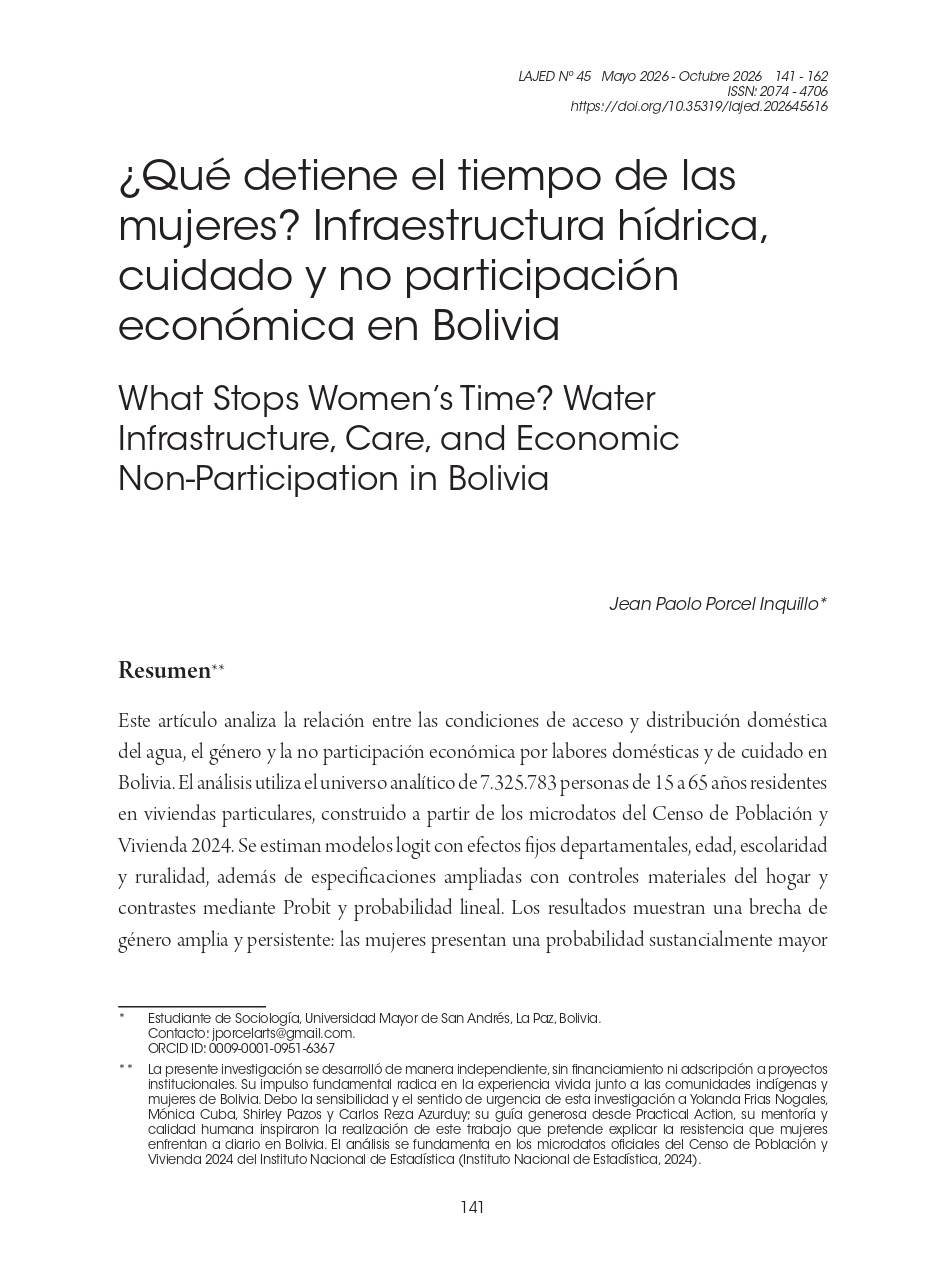
What Stops Women’s Time? Water Infrastructure, Care, and Economic Non-Participation in Bolivia
DOI:
https://doi.org/10.35319/lajed.202645616Keywords:
Water infrastructure, care work, time use, female economic participation, BoliviaAbstract
This article examines the relationship between household water access and distribution conditions, gender, and economic non-participation due to domestic and care work in Bolivia. The analysis uses the full analytical universe of 7,325,783 people aged 15 to 65 living in private dwellings, built from the 2024 Population and Housing Census microdata. It estimates logit models with departmental fixed effects, age, schooling, and rural residence, together with extended specifications that add material household controls and sensitivity checks using Probit and linear probability models. The results show a large and persistent gender gap: women are substantially more likely to report domestic and care work as the main reason for economic non-participation. Water constraints remain positively associated with this outcome even after introducing additional material household controls. The interaction between gender and water constraints is negative in non-linear specifications but changes sign in the linear model, so it should be treated as sensitive to functional form. These findings indicate that water infrastructure is a relevant, though not exclusive, material condition within the broader set of constraints affecting women’s economic autonomy.
Downloads
References
Akerlof, G. y Kranton, R. (2000). Economics and Identity. The Quarterly Journal of Economics, 115 (3), 715-53. https://doi.org/10.1162/003355300554881
Algül, Y. (2024). Assessing the Relationship Between Broad Gender Inequality and the Gender Unemployment Gap: Insights from an Extensive Global Macroeconometric Panel Analysis. Discover Sustainability, 5(1), 422. https://doi.org/10.1007/s43621-024-00663-y
Alkire, S. y Foster, J. (2011). Counting and Multidimensional Poverty Measurement. Journal of Public Economics, 95(7), 476-87. https://doi.org/10.1016/j.jpubeco.2010.11.006
Andersen, L. (2000). Social Mobility in Latin America. Documento de trabajo N° 3/2000. Instituto de Investigaciones Socio-Económicas (IISEC), Universidad Católica Boliviana. https://EconPapers.repec.org/RePEc:ris:iisecd:2000_003.
Becker, G. S. (1965). A Theory of the Allocation of Time. The Economic Journal, 75(299), 493-517. https://doi.org/10.2307/2228949
---------- (1991). A Treatise on the Family: Enlarged Edition. Harvard University Press. https://books.google.com.bo/books?id=NLB1Ty75DOIC .
Becker, G. y Tomes, N. (1979). An Equilibrium Theory of the Distribution of Income and Intergenerational Mobility. Journal of Political Economy, 87(6), 1153-89. http://dx.doi.org/10.1086/260831
Bertrand, M.; Kamenica, E. y Pan, J. (2015). Gender Identity and Relative Income Within Households. The Quarterly Journal of Economics, 130(2), 571-614. https://doi.org/10.1093/qje/qjv001
Bianchi, S., Milkie, M., Sayer, L. y Robinson, J. (2000). Is Anyone Doing the Housework? Trends in the Gender Division of Household Labor. Social Forces, 79(1), 191-228. https://doi.org/10.1093/sf/79.1.191
Blanchard, O. y Summers, L. (1986). Hysteresis and the European Unemployment Problem. NBER Macroeconomics Annual, 1, 15-78.
Cameron, A. C. y Trivedi, P. K. (2005). Microeconometrics: Methods and Applications. Cambridge University Press. https://books.google.com.bo/books?id=Zf0gCwxC9ocC
Chiappori, P. (1992). Collective Labor Supply and Welfare. Journal of Political Economy, 100(3), 437-67. https://EconPapers.repec.org/RePEc:ucp:jpolec:v:100:y:1992:i:3:p:437-67
Corak, M. (2013). Income Inequality, Equality of Opportunity, and Intergenerational Mobility. Journal of Economic Perspectives, 27(3), 79-102. https://doi.org/10.1257/jep.27.3.79
Devoto, F., Duflo, E., Dupas, P., Pariente, W. y Pons, V. (2012). Happiness on Tap: Piped Water Adoption in Urban Morocco. American Economic Journal: Economic Policy, 4(4, 68- 99. https://doi.org/10.1257/pol.4.4.68
Dickin, S., y Caretta, M.A. (2022). Examining Water and Gender Narratives and Realities. WIREs Water, 9 (5), e1602. https://doi.org/10.1002/wat2.1602
England, P. (2010). The Gender Revolution: Uneven and Stalled. Gender and Society, 24(2), 149-66. http://www.jstor.org/stable/27809263
Esping-Andersen, G. y Billari, F. (2015). Re-Theorizing Family Demographics. Population and Development Review, 41(1), 1-31. https://doi.org/10.1111/j.1728-4457.2015.00024.x
Espino, I., Hermeto, A. y Luz, L. (2022). Gender Differences in Time Allocation to Paid and Unpaid Work: Evidence from Urban Households in Guatemala, 2000-2014. Community, Work & Family, 27, 154-69. https://api.semanticscholar.org/CorpusID:252801389
Espinoza, S., Forni, L., Lavado, A., Olivera, M., Tapia, C., Vega, B., Balderrama, M. y Escobar, M. (2022). Connecting Water Access with Multidimensional Poverty: The Case of Tupiza River Basin in Bolivia. Water, 14(17), 2691. https://doi.org/10.3390/w14172691
Fraser, N. (1990). Rethinking the Public Sphere: A Contribution to the Critique of Actually Existing Democracy. Social Text, 25/26, 56-80. http://www.jstor.org/stable/466240
Gasparini, L., Cruces, G. y Tornarolli, L. (2011). Recent Trends in Income Inequality in Latin America. LSE Research Online Documents on Economics. London School of Economics; Political Science, LSE Library. https://EconPapers.repec.org/RePEc:ehl:lserod:123059
Goldin, C. (2006). The Quiet Revolution That Transformed Women’s Employment, Education, and Family. American Economic Review, 96(2), 1-21. https://EconPapers. repec.org/RePEc:aea:aecrev:v:96:y:2006:i:2:p:1-21
Goldscheider, F., Bernhardt, E. y Lappegård, T. (2015). The Gender Revolution: A Framework for Understanding Changing Family and Demographic Behavior. Population and Development Review, 41(2), 207-39. https://EconPapers.repec.org/RePEc:bla:popdev:v:41:y:2015:i:2:p:207-239
Gronau, R. (1977). Leisure, Home Production, and Work-The Theory of the Allocation of Time Revisited. Journal of Political Economy, 85(6), 1099-123. https://EconPapers.repec.org/RePEc:ucp:jpolec:v:85:y:1977:i:6:p:1099-1123
Hausman, J. (1978). Specification Tests in Econometrics. Econometrica, 46(6), 1251-71. https://EconPapers.repec.org/RePEc:ecm:emetrp:v:46:y:1978:i:6:p:1251-71
Hochschild, A. y Machung, A. (1989). The Second Shift. Working Families and the Revolution at Home. Estados Unidos: Viking.
Ilahi, N. y Grimard, F. (2000). Public Infrastructure and Private Costs: Water Supply and Time Allocation of Women in Rural Pakistan. Economic Development and Cultural Change, 49(1), 45-76. https://EconPapers.repec.org/RePEc:ucp:ecdecc:doi:10.1086/452490
Instituto Nacional de Estadística (2024). Censo de población y vivienda 2024: Microdatos de cuestionario censal (persona y vivienda). La Paz, Bolivia. https://www.ine.gob.bo/
Jalan, J. y Ravallion, M. (2003). Does Piped Water Reduce Diarrhea for Children in Rural India? Journal of Econometrics, 112(1), 153-73. https://doi.org/10.1016/S0304-4076(02)00158-6
Kleven, H., Landais, C. y Søgaard, J. (2019). Children and Gender Inequality: Evidence from Denmark. American Economic Journal: Applied Economics, 11(4), 181-209. https://doi.org/10.1257/app.20180010
Koolwal, G. y Van de Walle, D. (2013). Access to Water, Women’s Work, and Child Outcomes. Economic Development and Cultural Change, 61(2), 369-405. https://EconPapers.repec.org/RePEc:ucp:ecdecc:doi:10.1086/668280
Moser, C. (1989). Gender Planning in the Third World: Meeting Practical and Strategic Gender Needs. World Development, 17(11), 1799-825. https://doi.org/10.1016/0305-750X(89)90201-5.
Neidhöfer, G. (2019). Intergenerational Mobility and the Rise and Fall of Inequality: Lessons from Latin America. The Journal of Economic Inequality, 17, 499-520. https://doi.org/10.1007/s10888-019-09415-9
Porcel Inquillo, J. P. (2026). Repositorio del reanálisis empírico y soporte metodológico para el artículo “¿Qué detiene el tiempo de las mujeres?” GitHub. https://github.com/MonsieurUlupica/Porcel_Articulo_LAJED_2026_Analisis
Rawls, J. (1971). A Theory of Justice: Original Edition. Harvard University Press. http://www.jstor.org/stable/j.ctvjf9z6v
Sen, A. (1980). Equality of What? In S. M. McMurrin (Ed.), The Tanner Lectures on Human Values, 1, 195-220. Cambridge: Cambridge University Press / University of Utah Press
Shimamura, Y., Satoshi Shimizutani, S. T. y Hiroyuki, Y. (2022). The Impact of Better Access to Improved Water Sources on Health, Schooling, and Water Collection of Girls and Boys in Rural Zambia. The Journal of Development Studies, 58(9), 1750-71. https://doi.org/10.1080/00220388.2022.2048650
Solon, G. (1992). Intergenerational Income Mobility in the United States. The American Economic Review, 82(3), 393-408. http://www.jstor.org/stable/2117312
Stock, J. H. y Watson, M. W. (2015). Introduction to Econometrics. Always Learning. Pearson. https://books.google.com.bo/books?id=CZW0ngEACAAJ
Truelove, Y. (2019). Rethinking Water Insecurity, Inequality and Infrastructure Through an Embodied Urban Political Ecology. WIREs Water, 6(3), e1342. https://doi.org/10.1002/wat2.1342
Wooldridge, J. M. (2010). Econometric Analysis of Cross Section and Panel Data. The MIT Press. http://www.jstor.org/stable/j.ctt5hhcfr
Downloads
Published
How to Cite
Issue
Section
License
Copyright (c) 2026 Latin American Journal of Economic Development

This work is licensed under a Creative Commons Attribution-NonCommercial 4.0 International License.